






Michèle Lapointe
Et pourtant elle tourne
1995
Presentation of the artwork
The large window fully oriented on noon invites us to cross over towards the sun…to use the sun light to mark noon time. And the sundial idea was born.The idea seemed all the more interesting that, in a sundial, the angle of the style is the same as the latitude of the place in Ile Bizard, 45° 29' , which is also the same as the library roof angle. This concordance of angles brought the position of the style to naturally follow the roof pitch, in a kind of anchoring of the building right in the sundial centre. Passing through the roof and within the structure of the building, the sundial crosses the glass wall and move from outside to inside. The time thus should be read from the inside and is the true time of the library.
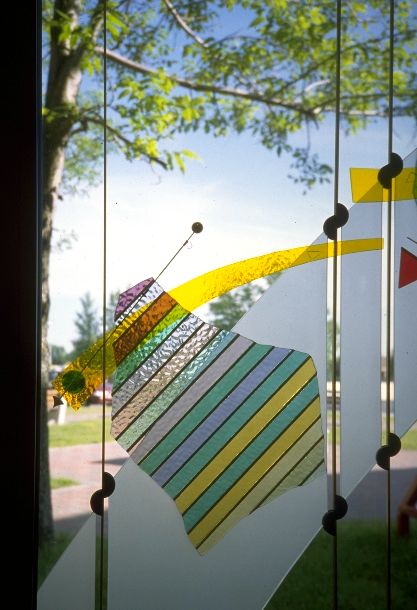
Following the 350th anniversary of Galileo’s death in 1642, the mural work is inspired by some historical ideas of cosmology. Galileo’s quote that gives the title to the work, remind us that, albeit the appearances, it is the earth who turns and moves around the sun. Like the sun is the pivot where the earth is linked to, the sundial becomes the centre where the library is attached.
There are some simple geometrical shapes reminiscent of pre-Copernican cosmic theories. And, to Galileo’s memory, the distribution of elements do not follow a circle arc, but the elliptical trajectory of the earth movement.
We can see comets, planets, nebulae, interference fringes, mesons, quarks and …the light …that, from an Einstein point-of-view, relativizes time to space by presenting us time in the symbolic contraction of the exterior space towards the interior of the library.


Michèle Lapointe

Michèle Lapointe was born in Montréal, where she still lives and works. Initially a self-taught artist, over the years she has taken various courses, including from Detlef Gotzens (engraving on glass) and Kevin Petrie (image transfer). She has taught at Espace VERRE since 1990. Her works are in the collections of the Montréal Museum of Fine Arts, the Musée de la civilisation de Québec, and the Musée national des beaux-arts du Québec.
Lapointe produced her first works of public art in the mid-1980s. She now has 15 to her credit, including Comme nos racines (1990), installed in front of the Repentigny city hall.
Lapointe produced her first works of public art in the mid-1980s. She now has 15 to her credit, including Comme nos racines (1990), installed in front of the Repentigny city hall.
Awards and honours
- Premier prix du jury, concours Une traversée de l'imaginaire, maison de la culture Marie-Uguay, 2002
- Finaliste à la Biennale du Grand prix des métiers d'art du Québec, 8e édition, 1996
- Ordre des arts et des lettres du Québec, 2023
- Prix Jean-Marie-Gauvreau, Conseil des métiers d’art du Québec , 2018
Presentation of the artwork
The large window fully oriented on noon invites us to cross over towards the sun…to use the sun light to mark noon time. And the sundial idea was born.The idea seemed all the more interesting that, in a sundial, the angle of the style is the same as the latitude of the place in Ile Bizard, 45° 29' , which is also the same as the library roof angle. This concordance of angles brought the position of the style to naturally follow the roof pitch, in a kind of anchoring of the building right in the sundial centre. Passing through the roof and within the structure of the building, the sundial crosses the glass wall and move from outside to inside. The time thus should be read from the inside and is the true time of the library.
Following the 350th anniversary of Galileo’s death in 1642, the mural work is inspired by some historical ideas of cosmology. Galileo’s quote that gives the title to the work, remind us that, albeit the appearances, it is the earth who turns and moves around the sun. Like the sun is the pivot where the earth is linked to, the sundial becomes the centre where the library is attached.
There are some simple geometrical shapes reminiscent of pre-Copernican cosmic theories. And, to Galileo’s memory, the distribution of elements do not follow a circle arc, but the elliptical trajectory of the earth movement.
We can see comets, planets, nebulae, interference fringes, mesons, quarks and …the light …that, from an Einstein point-of-view, relativizes time to space by presenting us time in the symbolic contraction of the exterior space towards the interior of the library.
Michèle Lapointe
Michèle Lapointe was born in Montréal, where she still lives and works. Initially a self-taught artist, over the years she has taken various courses, including from Detlef Gotzens (engraving on glass) and Kevin Petrie (image transfer). She has taught at Espace VERRE since 1990. Her works are in the collections of the Montréal Museum of Fine Arts, the Musée de la civilisation de Québec, and the Musée national des beaux-arts du Québec.
Lapointe produced her first works of public art in the mid-1980s. She now has 15 to her credit, including Comme nos racines (1990), installed in front of the Repentigny city hall.
Lapointe produced her first works of public art in the mid-1980s. She now has 15 to her credit, including Comme nos racines (1990), installed in front of the Repentigny city hall.
Awards and honours
- Premier prix du jury, concours Une traversée de l'imaginaire, maison de la culture Marie-Uguay, 2002
- Finaliste à la Biennale du Grand prix des métiers d'art du Québec, 8e édition, 1996
- Ordre des arts et des lettres du Québec, 2023
- Prix Jean-Marie-Gauvreau, Conseil des métiers d’art du Québec , 2018